Thursday, May 17, 2007

Random Interesting Fact #4: Colours (colors) of noise

You may have heard of white noise already. It is most often associated with that static sound when you get to a TV channel with no reception. However, there are many other colors of noise including: pink, brown, blue, purple and grey.

The colours of sounds are supposed to be analogous to the colours of light: for example, if you were to change the spectrum (energy formation) of purple sound and convert it into light, you get purple light.

Pretty weird. I came across this looking for a way to cancel the sounds from my fellow co-workers. It is said that pink noise can achieve this effect. But when it is playing directly in your ear, through earbuds, it's a little annoying.

Read more at Wikipedia: Colors of Noise


If you enjoyed these learning tips and motivational strategies, maybe you'll enjoy the other posts. Please bookmark this page (Ctrl-D) or check out the archive/categories to the right. Better yet, tell a friend! (Click the envelope below this.)

Labels:

Thursday, April 19, 2007

Random Interesting Fact #3: Utility

The concept of utility is useful to know in studying economics, biology, sociology, philosophy and even sweet, sweet mathematics.

Utility describes the happiness or value that you give to objects or actions. It may vary from person to person.

For example, while many people want money, one hundred dollars doesn't mean the same to me as it does to Bill Gates. The $100 bill has more more utility to me than to Gates; in other words, I get more pleasure from $100 than Gates does (so I would presume).

When people describe utilitarianism they often mistakenly say that it is a policy that ensures the greatest good for the greatest number of people. Like we should distribute money to everyone equally.

This is incorrect because it assumes that everyone gives the same amount of money the same utility: they say everyone gives money the same utility.

Utilitarianism actually tries to maximize the utility of the whole populace. So if giving all the money to one person would give the utility, then this is the utilitarian thing to do. My friend called this sort of person a "utility monster" because they have all the utility.

This stuff can get pretty heavy, but it is interesting to think of how this concept can be used. If you are interested, there are a lot of resources out there. A LOT.

Additional resources (opens in new window):
Wikipedia: Utility
Utilitarianism.com


If you enjoyed these learning tips and motivational strategies, maybe you'll enjoy the other posts. Please bookmark this page (Ctrl-D) or check out the archive/categories to the right. Better yet, tell a friend! (Click the envelope below this.)

Labels:

Wednesday, April 18, 2007

A free university / college education

If you share a love of free learning - with no cost or boundaries - here is a wonderful resource from the Massachusetts Institute of Technology (MIT):

MIT OpenCourseWare

MIT has graciously uploaded course lectures with topics ranging from astrophysics to feminist political thought.

As I love the idea of independent learning, content from one of the world's most renouned universities is priceless. (That was sort of a pun.) I have more to say about pursuing knowledge independently, but I'm saving that for a later post.

Currently, I'm studying the basics of general philosophy and philosophy of the mind. This will go a long way in helping me out: "Mind and Machines"

Some courses even have video and audio available.

Did I mention "free"?!

Here is a list of the topics they cover (note that there are many courses within these broad topics):


If you enjoyed these learning tips and motivational strategies, maybe you'll enjoy the other posts. Please bookmark this page (Ctrl-D) or check out the archive/categories to the right. Better yet, tell a friend! (Click the envelope below this.)

Labels: ,

Monday, April 02, 2007

Random Interesting Facts #2 - Gynecomastia
I read this in Scientific American, but this link is from HealthFinder.gov:
Personal-Care Products Can Spur Breast Development in Boys

If that title doesn't say it all, I'll briefly elaborate. It was found that some pre-pubescent boys were exhibiting gynecomastia (abnormal breast growth in men). After they stopped using products that contained tea tree oils and/or lavender, this condition subsided.

I should emphasis that lavender and tea tree oils have not been definitively shown to cause gynecomastia. (Correlation is not causation.) A proposed reason for this effect in pre-pubescent boys is that these chemicals mimic the effect of estrogen, which is one hormone responsible for inducing breast growth (usually in females though). As young boys have low levels of testosterone, a predominantly male hormone, they cannot counteract the effects of these estrogen-mimicing aromatics. Thus, man-boobs.

You shouldn't all stop using lavender and tea tree oil-containing products, but if you are a male that hasn't hit puberity, maybe you should keep this in the back of your mind.

Word of the day:
gynecomastia - abnormal growth of breast tissue in a male

gyneco- means woman; mast(o)- means breast or lump; -ia is a common disease/condition suffix


If you enjoyed these learning tips and motivational strategies, maybe you'll enjoy the other posts. Please bookmark this page (Ctrl-D) or check out the archive/categories to the right. Better yet, tell a friend! (Click the envelope below this.)

Labels:

Sunday, April 01, 2007

Random Interesting Facts #1 - p. vs. pp.
I come across a lot of random information that I think is pretty interesting. Often it is useful, but I find that I don't have a venue in which to tell people about them. So this will become a regular part of the Gravy Way landscape for a little while. Tell me what you think of them! And don't worry a real post is coming later tonight.


Although this seems to be important for academic texts, I never knew there was a difference between p. and pp. The first (p.) is what you write to cite a single page, but pp. is what you write to cite multiple pages. I wish I had known this earlier.

An example from my biochemistry lab, in the References section:

Prosser, D.D., & Boffa, M.B. (2006) BCHM 310 Laboratory manual. Queen’s Campus Bookstore, Kingston. pp. 86-96.

Voet, D., & Voet, J.G. (2004) Biochemistry 3rd ed. John Wiley and Sons Inc., Hoboken. p. 87.

(BTW, I'm aware that a lot of people know this already. However, since I didn't, I figure someone else could use this too!)


If you enjoyed these learning tips and motivational strategies, maybe you'll enjoy the other posts. Please bookmark this page (Ctrl-D) or check out the archive/categories to the right. Better yet, tell a friend! (Click the envelope below this.)

Labels:

Monday, March 19, 2007

Karl Iagnemma: Roboticist and Novelist

In an earlier life, and still now to a large extent, I have been guilty of compartmentalizing people based on their field of study or work. If someone is in the liberal arts, they must only be good at writing. If someone is in the sciences, they must only be good at memorization and analytical thinking. If someone is in drama, they aren't good at anything. Ouch! I'm just playing around.

While I've been learning that more and more people, maybe all people, are rich wells of varied abilities, I am still amazed at those people who can perform superbly in areas that greatly differ. My professor of the philosophy of medicine is not just an expert on this subject, but is also a hematologist.

In another clip from PBS's program, NOVA, MIT roboticist and acclaimed fiction novelist Karl Iagnemma (yanYEMma) is profiled. (The clip is about 10 minutes long and is viewable in a variety of formats.)

One of the amazing things to me is that he is not just a mediocre roboticist and novelist. He is outstanding in both fields. I won't ruin it all for you, but his book is quite popular and he is working in collaboration with NASA on a robot to go on Mars.

This profile is particularly encouraging because many people - myself included - have a desire to excel in more than just their field of study. Karl Iagnemma shows us that such a goal is definately attainable. We do not always have to be boxed in by our studies.

On a level closer to home, although our school work can be time-consuming, we should try to delve into our other interests. This isn't just to expand one's area of expertise, which is awesome too, but also to keep us sane and happy. In becoming engrossed in tasks that we enjoy doing, we get in touch with that pure present-moment happiness that we easily pass over.

It is a very zen idea, but I'm saving that for the next post. ;)

For now, go watch the video of the profile of Karl Iagnemma. It's quite inspiring.


If you enjoyed these learning tips and motivational strategies, maybe you'll enjoy the other posts. Please bookmark this page (Ctrl-D) or check out the archive/categories to the right. Better yet, tell a friend! (Click the envelope below this.)

Labels: , ,

Thursday, March 15, 2007

Forgotten Genius

Firstly, I'd like to apologize for my long absence. Due to schoolwork, job searching and a lot of other assorted goodness, I have been neglecting my other duties such as updating this website. For this, I am sorry. However, I would like to say that I will be updating more often now, even through the exam season. The next stint of updates will be directed towards informing you about specific topics in science that have piqued my interest. Hopefully, they will do the same for you.


Although this is quite late for Black History Month, I would like to draw your attention to noted chemist Percy Julian. Recently, NOVA, PBS's documentary-style science program, aired a documentary regarding his life, struggles and discoveries. Through the wonders of this internet age, we may easily (and freely) enjoy it online:

Forgotten Genius

It is quite compelling and inspiring to watch. Julian's story has it all: tension, explosions, perseverance, discovery, racism, money and more.

Here's a very brief summary: Julian grew up in the post-reconstructionist South of the United States; this was a time and place where racism abounded, even lynchings were regular. This documentary outlines his struggles to education and rise within the world of chemical synthesis. Throughout, race issues play a key role.

Why should you care about Percy Julian on a scientific basis?

Significance of Julian's work:

first to synthesize physostigmine: used to treat glaucoma among other things
first to efficiently synthesize progesterone (on an industrial scale): used in birth control pills
played key role in industrializing synthesis of cortisone: used to treat rheumatoid arthritis

Aside from the science aspects of this documentary, I found it notable how Julian's parents placed such a great importance of education. Almost to the extent of it bringing a type of liberation. In one way it did: it brought him prestige and opportunities that may have never come to a Black man of his day. Personally, I believe that education is the greatest investment one can make in their lives; in themselves or in others.

Of course there is the flip-side, had Julian been white or in a different place and time we would most likely have held the top scientific posts around the country.

The program later deals with the inequality in the sciences for Black people today. Although I will neither make any bold statements about why this may be nor will I play the blame game. I will point out that there is a large discrepancy between the proportion of Black scientists (at the Baccalaureate and Graduate levels) and the proportion of Blacks in the general population.

While we are pointing things out, there is also an underrepresentation of women in the sciences. As to why this may be is just as contentious as to the Black underrepresentation.

I must say that my unwillingness to take a stance on such issues is not because I have no stance, but because (a) I don't think this is the place for such arguments and (b) there are many, many facets to these issues that need further investigation. However, with that said, if you really want to have a discussion about this, there is a lovely place to comment below this post, and my inbox is always open.


If you enjoyed these learning tips and motivational strategies, maybe you'll enjoy the other posts. Please bookmark this page (Ctrl-D) or check out the archive/categories to the right. Better yet, tell a friend! (Click the envelope below this.)

Labels: ,

Wednesday, November 01, 2006

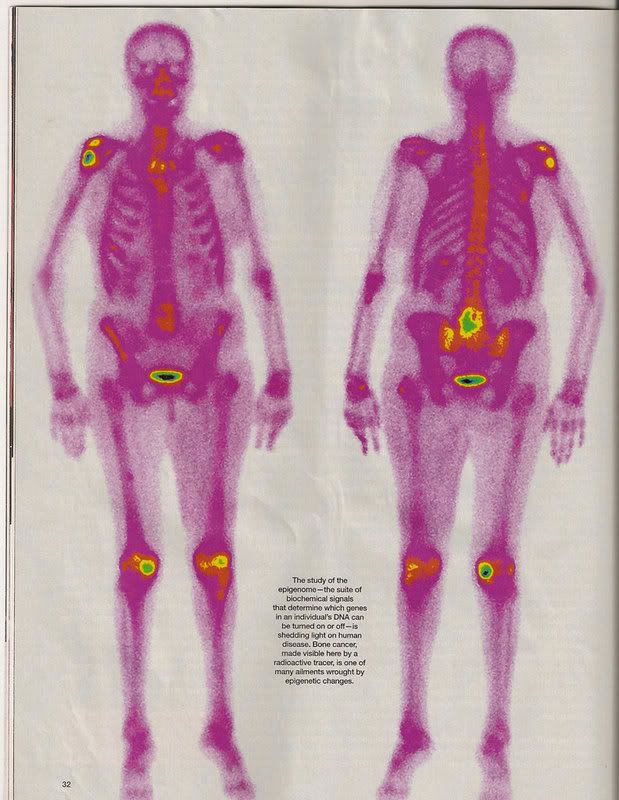
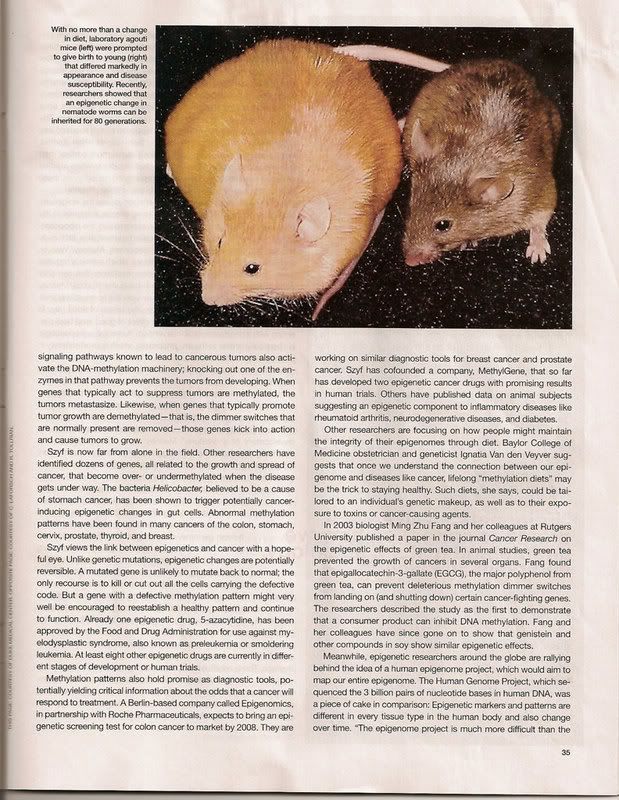
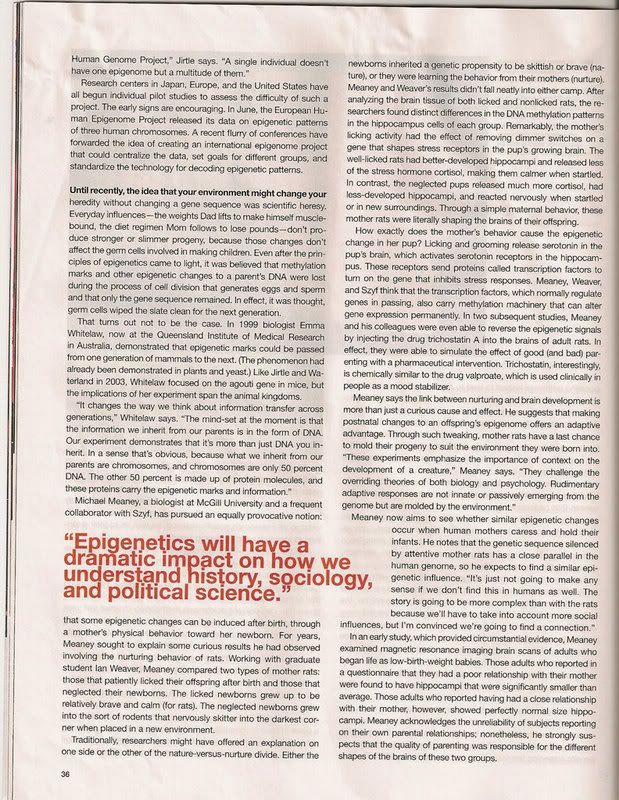
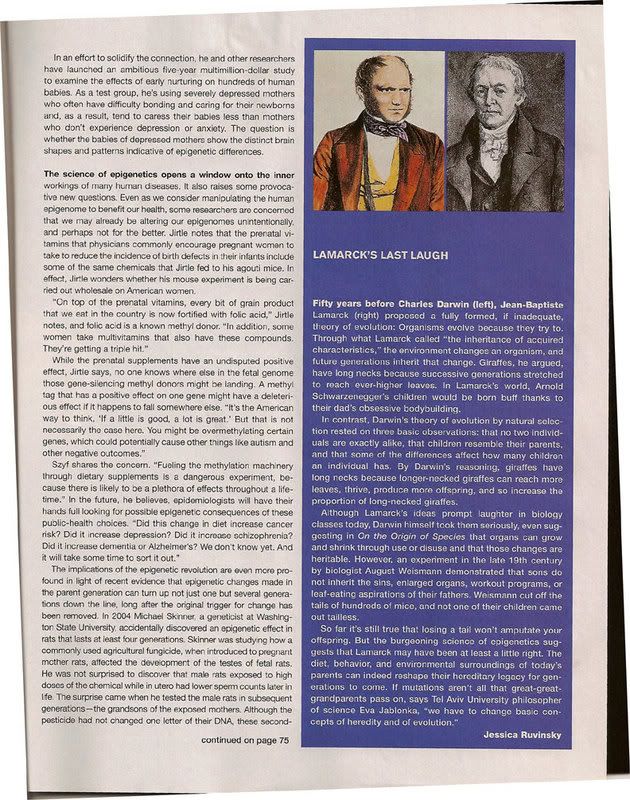
Discover Article: DNA is not your destiny

Here's a little change of pace. I was reading the November 2006 issue of Discover magazine and I came across an article describing the idea that we are not simply hard-wired for many of our traits--even the genetic ones.

(If I get too technical, which I know I will, and you want me to explain what I'm talking about to you: Try reading the article first, if that doesn't help, email me, and I'll see what I can do.)

While I don't want to get into a big philosophical argument, personally I do not believe in genetic determinism for the most part. This is basically the idea that we are a product of our genes.

The article describes some mechanisms through which we can change the way our genes are expressed: This can occur through the food we eat or even how one is raised. While there is much debate surrounding this issue still, I still like the idea that my notions are getting confirmed by science.

As well, with a little nod to Lamarck, the changes that occur to the expression of ones geneome may also be passed to future generations. This is to say that changes in habits that we make in our lives, can somehow be reflected in our offspring. This is quite a boot to the face of current neo-evolutionists. The idea of "inhereted acquired traits" is pretty weird.

Although I could talk about this for a long time, the reason I'm making this post is to share the article with you.

DNA is not your destiny: Page one, two, three, four, five, six and seven.

Feel free to discuss this article at the bottom, I have a lot of stuff to mention that I haven't gotten to. It's midnight, and I'm a little tired. So go and read this article; you may end up learning something incredible!


If you enjoyed these learning tips and motivational strategies, maybe you'll enjoy the other posts. Please bookmark this page (Ctrl-D) or check out the archive/categories to the right. Better yet, tell a friend! (Click the envelope below this.)

Labels:

Sunday, March 12, 2006

Knowledge and Relationships

I've been reading a book called The Tipping Point by Malcolm Gladwell, and I just wanted to share an excerpt that I found very interesting. It may not help you do better in school, but it's something to think about.
When we talk about memory, we aren't just talking about ideas and impressions and facts stored inside our heads. An awful lot of what we remember is actually stored outside our brains. Most of us deliberately don't memorize most of the phone numbers we need. But we do memorize where to find them -- in a phone book, or in our personal Rolodex.
[...]
Perhaps more important, though, we store information with other people. Couples do this automatically. A few years ago, for example, [Daniel] Wegner [of the University of Virginia] set up a memory test with 59 couples, all of whom had been dating for at least 3 months. Half of the couples were allowed to stay together, and half were split up, and given a new partner whom they didn't know. Wegner then asked all the pairs to read 64 statements, each with an underlined word, like "Midori is a Japanese melon liqueur." Five minutes after looking at all the statements, the pairs were asked to write down as many as they could remember. Sure enough, the pairs who knew each other remembered substantially more items than those who didn't know each other. Wegner argues that when people know each other well, they create an implicit joint memory system -- a transactive memory system -- which is based on an understanding about who is best suited to remember what kinds of things. "Relationship development is often understood as a process of mutual self-disclosure," he writes. "Although it is probably more romantic to cast this process as one of interpersonal revelation and acceptance, it can also be appreciated as a necessary precursor to transactive memory." Transactive memory is part of what intimacy means. In fact, Wegner argues, it is the loss of this kind of joint memory that helps to make divorce so painful. "Divorced people who suffer depression and complain of cognitive dysfunction may be expressing the loss of their external memory systems," he writes. "They once were able to discuss their experiences to reach a shared understanding. . . . They once could count on access to a wide range of storage in their partner, and this, too, is gone. . . . The loss of transactive memory feels like losing a part of one's own mind."
Simply fascinating. The Tipping Point by Malcolm Gladwell is an amazing read, full of many examples and theories of how small changes can push circumstances past their tipping point.

Labels: ,