Wednesday, January 24, 2007

The Monotillation of Traxoline

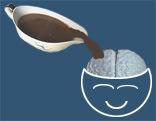
Brad Hoge at the HUNBlog wrote a very poignant post regarding the problems that can come about through lecturing and test making; in this post he makes reference to the monotillation of traxoline: in this post he floods you with jargon from an imaginary field, then quizzes you on the same.

I’ll give you an example from biochemistry, if you don’t feel like reading his post and because it hits so close to home for me:

Regulation of Glycogen Metabolism

The primary mode of glycogen regulation is through covalent modification of enzymes. Protein kinase A is a second-messenger activated member of the phosphorylation system. It in turn phosphorylates phosphorylase kinase, glycogen synthase (inhibiting it), and phosphoprotein phosphatase inhibitor. It is important to note that only phosphorylated phosphorylase kinase works to phosphorylate glycogen phosphorylase, activating it, thereby increasing glucose-1-phosphate concentrations. With reference to phosphoprotein phosphatase inhibitor, it only binds to and inhibits phosphoprotein phosphatase in its phosporylated form. It is clear that phosporylation works to promote glucose synthesis and dephosphorylation works to promote glycogen synthesis.

I was going to ask you some questions about the blurb above, but I think you get the point.

While Dr. Hoge later speaks about this in terms of constructionism, I’d like to deal with it in a different light.

First, I would like to address the nature of teaching; then I would like to talk about the student’s level of understanding.

Pedantic teaching

Sometimes I wonder if teachers know they are being so dull. Sometimes I wonder if they are trying to be confusing. As I try to see things in a better light however, I don’t think either of these is true. Teachers, professors, etc. are quick to assume that students have completely absorbed the content of their previous lecture. Of course, there is a lot ofonus (responsibility) on us to learn the material; however, as with learning a new language, one must first be immersed in the new knowledge, then given time for that new vocabulary to be incorporated into one’s lexicon (personal dictionary).

Ancient wisdom tells us that we must walk before we can run. In terms of knowledge acquisition, we must be familiar with ideas before we can use them. To use the language-learning example, we should learn to listen and read before talking and writing.

Hey, so what does this mean for us (students)?

In the absence of sympathetic teachers/professors, we will have to work to become familiar with the knowledge faster. How can we do this you ask? I’m sure you can feel it coming: We have to immerse ourselves in the content, by listening and/or reading more. Try to assimilate as much of it as possible, but don’t fret too much if it all doesn’t sink in right away. Even that reading, as incomprehensible as it seems, is starting to build those neural pathways in your brain that will lead to understanding.

Stick with it; the comprehension will come. Case in point: You know that biochemistry blurb up there? I couldn’t have written is unless I had a relatively good understanding of the concept. A week ago, I couldn’t tell a phosphotase from a kinase—in simpler words, I couldn’t tell an apple from an orange.

What does this mean for teachers?

For teachers this means, giving students the opportunity to become familiar with these new ideas before making them the foundation of future lessons. Some more ancient wisdom: Build your house on sand and when the winds come, it will be a great fall. (That’s adapted from the bible, by the way.) I realize there are time constraints, but there’s no point in teaching, if no one is learning.

How can one find out if people understand? Try to ask students candidly if they understand the material. Students of all sorts, however, are not always willing to stick their necks out. You may have to probe their knowledge base with key questions. It can be hard, but awareness of the students’ level of comprehension is very important to teaching and learning.

Level of Understanding

I was in one of my labs, and I heard someone say, “Yeah, [that professor] knows too much to explain things easily.”

Initially, I thought this sounded silly, but I realized there was some credence to this comment. When one is at a certain higher level of knowledge, it’s hard for them to speak in terms of a former lower level of knowledge. Its hard to talk about politics simply, if you are so used to understanding and using political jargon, for example.

This is why teaching is such an art. The best teachers have learned to speak in terms of a common lexicon, so that more of their students may have a chance of understanding them.

The highest level of understanding is not when one can explain a concept in a complicated way, but instead when one can explain a complicated concept in a simple, succinct way. (I know there is another ancient wisdom quote that espouses this, but I couldn’t find it.)

For students, this means that we should strive for that higher level of knowledge. When we can explain concepts simply, we truly understand the material.

Often, I find that when my friends ask me about a recently learned concept, they cannot understand what I am talking about. This isn’t purely their fault; my explanation is weak, because my level of understanding is low. Once we augment our knowledge, we can give better explanations. That is true mastery.

So, inspired by the hilarious graph-based comic Indexed, I have decided to create a graph showing the relationship between Level of understanding and Complexity of explanation. (It looks a lot messier than I expected.)

Parabola of knowledge:


So students and teachers alike, remember to strive for the simple and clear explanation: it shows that you truly understand the material, and it will make everyone else’s life a lot simpler in the long run.


If you enjoyed these learning tips and motivational strategies, maybe you'll enjoy the other posts. Please bookmark this page (Ctrl-D) or check out the archive/categories to the right. Better yet, tell a friend! (Click the envelope below this.)

Labels: , ,

Tuesday, January 16, 2007

You can remember everything

... Almost.

More and more, just from experience and from learning about cognitive psychology, I’ve found that we can remember much more that we thought. Even seemingly lost facts, places, faces, etc. can be found.

How can we perform such amazing feats? Through associative memory. (Those of you with some psychology background may not be too surprised.) In fact, this post is inspired by one cognitive neuroscientist who won $500,000 on Who Wants to be a Millionaire? (A highly recommended read.)

The thing here is that while some people may have heard this before, it is something else completely to understand and apply this. Personally, I use 3 methods for extracting factoids from my head.

Think about:
  1. Related words/ideas
  2. the Situation you were in when you learned it
  3. Insane, random ideas
So for related ideas, if you are trying to remember the name of a perfume, think about a bunch of other perfumes or people that advertise them. I was trying to remember the type of perfume that my mom likes: Hmm, what was it? Not Channel No. 5. What person? Jennifer Lopez? Hell no. Elizabeth Taylor. Got it, White Diamonds!

Maybe that example was too metrosexual for you, maybe these other ones will make more sense.

For situational memory (or episodic memory), sometimes smelling something like a musty basement can bring back a flood of memories about playing table tennis oh-so-many years ago. In the same way, sometimes remembering where you were in the hallway in front of a washroom, when your friend mentioned magic mushrooms, the chemical muscarine (one chemical in some “magic mushrooms”) and your over-excited/under-clothed friend, can bring back memories that will help you on a pharmacology exam.

Frankly, when I’m really stuck, I like thinking of really insane, random things. If you have extra time during a test or anytime in life, I recommend this; it gets your brain moving in on a totally new path, which can get you out of that mental rut.

I’m going to use one of my dreams as an example, because I know people are getting a little tired of my arcane life sciences examples.

I had a dream last night, but when I woke up I only had the “feeling of a dream” left. Since I wanted to remember the dream, I stayed positive (important for letting those thoughts come back) and started looking around my room for associations. I looked at my headphones, and thought about a memory program I was listening to. Then I thought about books: from this I got a strong feeling that a book or books were important. Then I looked at the books in my room and saw one about the Korean language—suddenly I remembered my whole dream. (If you’re that curious as to what it was, you can ask in the comments.)

To get some free associations (to start the brain cascade), I don’t just look around wherever I am; sometimes I use a preset A-Z list of items (a peg list), body parts, random songs. It doesn’t actually matter what you choose, as long as you create some associations, and you go along with those that pull at your intuition.

I’m not saying that you will remember everything with this sort of thinking. If you are confident in yourself and your brain, however, you will remember a lot more than you previously thought possible.

Try it! Seriously! Try to connect “string” to your past, and just go with it. Appreciate all the rich associations that you make, and you’ll begin to appreciate what sorts of connections you are capable of. Inside of those connections and associations is an insanely large amount of information.


If you enjoyed these learning tips and motivational strategies, maybe you'll enjoy the other posts. Please bookmark this page (Ctrl-D) or check out the archive/categories to the right. Better yet, tell a friend! (Click the envelope below this.)

Labels: , , ,

Friday, September 01, 2006

Experiments in learning that don’t explode

As people make the transition from high school to university they find that many aspects of their lives and mindsets change. A newly discovered freedom – or at least awareness – causes people to reassess what they know to be true or good.

Naturally, this leads to a lot of experimentation. In university such experiments may involve alcohol, drugs, sexuality, social interaction, physical activity and much, much more.

While I will neither condone nor oppose these types of experimentation, I think that people must come into their own perspective in their own way. Might I suggest one more – oft overlooked – area of experimentation? The way you learn.

This is the perfect time to experiment with your learning. Right now, we are still relatively young. Even if you are not, there is a comparatively small time investment needed in order to improve the way you learn. Think about it: if you spent one year trying out new learning techniques – honing in on what suits you the best – then even if you only live ten more years (definitely more though), you will have ten more years of improved learning. Relating this back to Monday’s post, it would be a very solid investment.

In finding out the nature of the way you gain knowledge you can increase the speed and ease of your learning. Taking in information will become less of a chore and more of an incidental process – or better yet, it will become fun.

I would recommend reflecting on all the areas and ways in which you learn. However, to get the ball rolling, I’ll give you some examples:

In-class note taking

How do you take notes in class? Do you write down everything? A lot of professors tell me not to, but then it seems like I’m missing something from my notes when I come back to them. There’s a line between expediency and deficiency. Work to find what works or what doesn’t work for you.

As well, have you ever tried previewing the material before class or reviewing afterwards? I must say it’s really helpful. Even if you don’t fully grasp the material at the time, you’ll find that even the mention of something vaguely familiar during the lecture will boost your confidence and increase your attention span.

I have already written a post describing Note Taking Tips (in class).

Listening to music
I’ve heard many arguments from both sides, so I’m hesitant to render a verdict for either. I’ll give you what I know, and what works for me.

Some people say that studying with music allows them to keep focused longer and keep a nice tempo going to their work. Some people say it energizes them. There was even a system, popular in the mid-1980s, called Super Learning [new window] that taught that people learned best while listening to 60 beat-per-minute Baroque music.

On the other hand, personally I’ve found music to be too distracting. I always want to start singing along, drumming things, etc. I’ve had a few teachers say that music can be distracting, but I usually take their advice with a grain of salt. A while ago, my friend mentioned a study done where participants learned some material with and without music. The variable was the level of musical competence of the subjects. Can you guess who learned better with or without music?

Well, I guessed wrong. Actually, the people with a higher level of musical competence actually learned more poorly when they listened to music. This makes sense, because their brain would become more active in the “musical areas” of the brain; taking focus away from the studied material. (I believe Jenna told me this, so if you are reading this and I have misquoted you or the study, go ahead and correct me.)

However, I have to mention that I have been listening to music on an off while writing this post…

Study Groups

I don’t know if I’ve mentioned this already. Many people find that study groups help them by bringing people together to teach and learn the material. I find that teaching others helps to solidify the material in my mind. When you actually have to explain something, you have to have a higher and more complex level of knowledge about the subject. Personally, I don’t like study groups because I’ve found that we get too easily distracted and start talking about the Nintendo Wii or shoes. Try it out for yourself!

And more!

I have written other posts regarding the following things you should try experimenting with:
  • Memorization techniques – This is probably one of the most valuable techniques you will learn.
  • Environment – You may want to incorporate things that help you learn, calm you or provide motivation.
By the way, you should also try to expand this philosophy to other aspects of your life. A change in diet can change your energy levels and even the way you think. An occasional reassessment of your personal beliefs can also bring about lasting positive change in your life.

Keep your experimentation positive and you can’t go wrong. Without change there cannot be growth; growth is the key to life. So get growing!


If you enjoyed these learning tips and motivational strategies, maybe you'll enjoy the other posts. Please bookmark this page (Ctrl-D) or check out the archive/categories to the right. Better yet, tell a friend! (Click the envelope below this.)

Labels: , , , , , ,

Saturday, May 13, 2006

Take advantage of all available resources

In studying or test-preparation you should see what options you have to get an upper hand in performing better. Most of these choices are little shortcuts that will make your studying go a lot more smoothly.

Old tests
At a higher level of education, the format of the test and phrasing of questions becomes increasingly difficult and can be a barrier to performing . I don’t mean that the content is not important, it always is; however, if you aren’t used to a particular way a professor phrases questions or a radically different testing format, then it can throw you off.

Furthermore, as I have mentioned earlier, I love the idea of testing yourself in order to perform better. The idea of using old tests in order to quiz yourself seems perfect.

As a word of caution though, there are two things to be aware of: 1) The material taught from year to year can change, so the focus of the test can change. This means that you might not be tested on the proper material for some sections. 2) The idea of obtaining previous years’ exams may seem like cheating to some – if they aren’t already offered by the university. Frankly, I see no problem with obtaining previous years exams if you can, it is just another method of studying. However, if you’d like to discuss it, comment below or email me (the address is on the right sidebar).

Discussion Boards
Many universities offer course websites with associated discussion boards where students can exchange information, questions and answers regarding the course content. Take full advantage of this service. You can read other people’s questions, because maybe you haven’t thought of a problem in a certain way. If you have a question that you don’t want to ask the professor directly, try this – sometimes the professor or teacher’s assistants will reply. This reminds me that you should try asking your professor some questions after a lecture or during their office hours. I will say that most of them in my experience are willing to help out any student as along as they are eager to learn and have tried to answer the question beforehand.

Once again, another word of caution: With peer responses, take them with a grain of salt. Sometimes people like saying answers that sound good, but aren’t correct – not necessarily through any ill will, they just don’t know better.

Internet searches
Maybe you were wondering why I chose that picture to start this entry off. It’s from . I am very big on independent learning. I have found that the internet has a wealth of knowledge for anyone who wants it. And by the picture you can see that Google is my search engine of choice.

If you want to learn to play the guitar: Search for "guitar lessons".
If you want to know about Fermat’s Last Theorem, just search for "Fermat’s Last Theorem".

Wikipedia deserves a mention, simply because it is so amazing. There are entries on very widely varying topics. May I recommend a look at the entry for Snowclone, because I think it’s interesting (it doesn’t relate to this at all though).

Friends
Hopefully, your friends will be willing to help you out occasionally if you need some help with academics and you should be willing to do the same. Don’t be too shy about it, just ask. You’ll be able to judge by their reaction whether you will be asking again. :P

I’d like you guys to remember something though: If someone helps you out, you should try to repay them. Teaching/helping someone can take a lot of effort or time – as many of you, and myself, know. Anything is fine, coconut cream pies, drinks, etc. Taking without giving doesn’t really work out in the end.

Textbooks and associated learning tools
Queerly enough, people are willing to shell out 50-200 dollars for a textbook and be perfectly content using it as a paperweight. There is probably a reason that it is required reading for your course. Try using it once in a while. It will help further clarify lessons and usually the diagrams really make things easier to grasp.

These days, many textbooks come with CDs or additional books, etc. You should see what help these supplements can provide, you may be surprised.

And if I know one thing about professors, it’s that they are a tricky bunch. If they don’t mention the textbook, there will still definitely be questions directly from the book on it. Unless they specifically say that you don’t need to read the textbook, there will be questions from it. A little sneaky, I know; that average isn’t pushing itself down though…


There are many other resources that I’m sure I’ve omitted – feel free to add them to the comments below – but I hope you get the point. Use all the resources you have around you to get a little more of an edge in learning – every little bit will help.


If you enjoyed this post, maybe you'll enjoy the others. Please bookmark this page (Ctrl-D) or check out the archive/categories to the right. Better yet, tell a friend!

Labels: , ,

Thursday, May 04, 2006

Just go to sleep

Alright, sorry about the lack of posting. You know how exams are... and then I had to move. Try to move as little as possible, it's not fun.

I think I'm going to reduce the posting frequency to a weekly basis for a month or so. I'll be starting an MCAT course on the 19th of May so that should give me something to talk about. We'll see what happens.

On to the post:

I've been noticing more and more people attempting to pull all-nighters in an attempt to desperately cram more information in their heads the night before an exam. I've even seen some highschool students do this. That's just craziness.

There is a point when we should all probably just stop studying and just get some sleep. I say this for two big reasons:

1) When you are really tired, you are probably not learning very effectively - if at all. This means that you are just wasting your time, and losing sleep. Along with this, there's the fact that you will be tired during the exam which will slow your thinking and will cost you marks on the exam.

2) In the end, is it really worth it to kill yourself for school? If your answer is 'Yes', then maybe you should reassess your priorities. I will be the first to say that school and learning are very important things; however, it is not worth dying over.

I'm going to say this even though no one likes hearing it: You should probably work harder a bit earlier to avoid this sort of situation. I know, I know. The XBOX 360 is a sweet system, the summer is really beautiful, Scrubs is a really good show. But the summer and XBOX 360 will still be around after your tests, and you can just record those TV shows.

Oh and as a little sidenote: If you stay up until 4 and try to wake up for 7 to prepare for your exam. You should just stay up or get a friend to wake you up. Because you may just end up sleeping through your exam. I won't name names, but let's say I know a person who did this really recently. Let's say I know them really really well...

The point is: All-nighters aren't worth it.

If you disagree with me and find that all-nighters are awesome, feel free to comment or email me, I'd love to hear from you.


If you enjoyed this post, maybe you'll enjoy the others. Please bookmark this page (Ctrl-D) or check out the archive/categories to the right. Better yet, tell a friend!

Labels: , ,

Monday, April 17, 2006

Read Instructions Carefully

Those directions are there for a reason. For your sake, mostly.

I was making some popcorn in a pot – I was trying a healthier alternative to the pre-flavoured microwave stuff. I read some instructions on the internet saying that if you coat the bottom layer with kernels, the popped kernels will expand 6 inches from the bottom of the pot. He emphasized that the depth of the pot was key.

I took a look at my pot – 4 inches tall – and figured it would be fine.

No such luck.

Once the popcorn gets popping, it really gets popping! Lid was shaking because I was shaking the pot. So far so good. Then the lid started rising… “Oh well,” I thought, “it looks like it’s going to stop any minute now” Of course it didn’t. The very dry and starchy popcorn fell over the sides of the pot and hit the element. This in turn, you guessed it, started a small series of fires.

Luckily, cooler heads prevailed. After a sprinkling of water and profanities, the fire was quenched.

So, why am I telling you all this?

This minor disaster could have been prevented if I had done the following:
(a) Paid attention. (b) Followed some easy instructions.

Since this site is about learning, education and such, I hope you are starting to see how this can apply. In particular, mere seconds after extinguishing the flames, I thought about how this could apply to testing.

Have you ever screwed up something on a test, just because you didn’t read the directions properly? I’ll use a history example: you were supposed to write down the location beside a series of battle names, but you were so used to memorizing the years that you put those instead. Misreading a question that could have been really easy can waste a lot of time or cost you marks.

This is a very simple message; the trick though– like so many things – is in the follow-through. We should keep a cool head and read things slowly, maybe even a few times. This will ensure we don’t make any silly mistakes, and will prevent minor disasters.

Well, unless you set your paper on fire, but then you probably have bigger problems.


If you enjoyed this post, maybe you'll enjoy the others. Please bookmark this page (Ctrl-D) or check out the archive/categories to the right. Better yet, tell a friend!

Labels:

Sunday, April 09, 2006

Quiz Yourself First

So you read that chapter from your textbook a few times. You seemed to have a strong grasp on the material. Then the test rolls around and… that whole chapter is a blur. You remember some major concepts, that picture at the beginning of the chapter (yet another molecule – real creative…) and maybe you remember question 17.3 – but it wasn’t even that hard.

This is not what you were expecting. Sucks doesn’t it?

How can we prevent such disasters from occurring?

Preparation. And lots of it.

It isn’t enough to merely read the text a few times, and expect to do well. How will you know if you are absorbing the material? This is where problem-based learning comes in. In this case, problem-based learning encompasses asking yourself some questions about the material.

In questioning yourself on the material, you are forcing your brain to go into the retrieval mode that is oh-so-necessary for any test.

Problem-based learning can help you in another way. One of the keys to learning is to have multiple mental pathways that can lead you to the same set of facts.

For example: Let’s say that you are trying to remember how Hamlet’s father was killed.
  1. The first thing you remember is that he was murdered while sleeping; because you know that Claudius is a rank man-whore. Oh, he was killed in some weird way, no knives or anything like that… something with poison… poison in the ear! Claudius poured poison into Hamlet’s father’s ear!
  2. Or, you could have only remembered ‘ears’ and eventually reached ‘poison in the ear’ through another pathway.
Where am I going with this? Questioning yourself (especially from different tacks/approaches) helps to create these mental pathways. The more you create, the greater chance you have of landing on at least one of them on a test.

So to get on the problem-based learning train, you will have to get some questions to ask yourself, or have others quiz you. Ask around, usually people would like this opportunity as well.

Now when asking questions, you have to be real with yourself. Include all material that might show up, even if it is difficult. It is better to get a question wrong in your room seven times, than to lose those marks on a test.

I may have mentioned that I love giving myself questions to learn. If possible, I prefer to incorporate them into broad concepts. It is easier to learn one large idea and its subtopics rather than a bunch of disjointed concepts.

I’ll give you an example of a question I’ve asked myself to study for anatomy (apologies if it flies over your head, I’ll do my best to translate):
How do the epithelial cells (cells lining a space) change along the urethra as we move distally (from the bladder to the external opening)? And relate these changes to functional changes.

(That question sounds a lot harder than it is.) With that question, I am forcing myself to recall the varieties of epithelium along the urethra, while also relating that variation to the change in function.

I do this so that when I have to recall this information later, the potential for numerous mental pathways is large, because the remembered concept is itself large. This increases the likelihood that I will remember the information more readily on a test.

If you are wondering what process you should go through to learn in this manner, it is fairly simple:
  • Quickly scan over a small section – i.e. a lecture or one chapter.
  • Go through the lecture/chapter again and write questions that will extract the answers in the text from you.
    • You may want to put the answers afterwards – it takes more time, but it is easier to retrieve the answer if you are stumped.
  • Read the information again.
  • Try to answer the questions.
  • Find out what you don’t know.
  • Do something else (e.g. the next lecture set, jump in some puddles, eat a 72oz. steak, etc.)
  • Try answering the questions again.
Generally speaking, I try to ask myself the questions until I run out of time, or I know the information so well that I barely even need the question sheet. In this way, I ensure that I know pretty much everything for the test.

With this technique, you will find that you can recall information more readily by creating new mental pathways and putting your brain in retrieval mode. So go and ask yourself some questions! Seriously, ask!


If you enjoyed this post, maybe you'll enjoy the others. Please bookmark this page (Ctrl-D) or check out the archive/categories to the right. Better yet, tell a friend!

Labels: , , ,

Tuesday, April 04, 2006

Priming yourself to be smarter

In my continuing fascination with how our brains work, I decided to pick up Malcolm Gladwell’s Blink (new window), after reading his earlier book, The Tipping Point (mentioned in the post: Knowledge and Relationships).

Once again I am highly recommending this book. This book is just as, perhaps more, fascinating than The Tipping Point.

To the point: Gladwell suggests that we can be prepared or primed to think in a particular way with some simple and subtle suggestion.

From Blink by Malcolm Gladwell:
[T]he effects of priming aren’t trivial. Two Dutch researchers did a study in which they had groups of students answer forty-two fairly demainding questions from the board game Trivial Pursuit. Half were asked to take five minutes beforehand to think about what it would mean to be a professor and write down everything that came to mind. Those students got 55.6 percent of the questions right. The other half of the students were asked to first sit and think about soccer hooligans. They ended up getting 42.6 percent of the Trivial Pursuit questions right. The “professor” group didn’t know more than the “soccer hooligan” group. They weren’t smarter or more focused or more serious. They were simply in a “smart” frame of mind, and clearly, associating themselves with the idea of something smart, like a professor, made it a lot easier – in that stressful instant after a trivia question was asked – to blurt out the right answer. The difference between 55.6 and 42.6 percent, it should be pointed out, is enormous. That can be the difference between passing and failing.
The implications here are wild! To me, it seems that before any sort of testing situation, it is possible for us to prime ourselves to think in that “smart” frame of mind.

Rather than thinking about hooking up with that cute guy/girl right before the exam, our thoughts should be of greatness and intelligence. It may help to think of someone you think of as smart, or what it means to be smart.

And hey, even if it improves your mark by only 1%, it’s a free percent that takes only minutes before an exam. Two minutes for one percent? I’ll take that any day.


If you enjoyed this post, maybe you'll enjoy the others. Please bookmark this page (Ctrl-D) or check out the archive/categories to the right. Better yet, tell a friend!

Labels: , , , ,

Monday, March 06, 2006

Test Taking Tips

It's OK to change your answer after thinking about it

I always hear that people hate changing their answers because whenever they switch it, they were right the first time. Although this can be the case in many situations, I propose that people just remember the damn-I-should’ve-left-it times more often than the thank-goodness-I-switched-it times. People are inherently more sensitive to pain than pleasure.

I think that if you think about something long enough, given the time and reasoning, and arrive at a different answer, you’re probably right. Now you have had more time to think about it and attack it from different angles. This causes me to want to…

Stay even if you finish early.

Double-check your damn answers. There is no excuse for a stupid mistake if you have the time to double-check. Coloring in the wrong bubble, reading one word incorrectly, etc. These things can and do happen. So we have to make sure that we catch them before those scantrons hit the marking machine.

Pee before the test

Thirty minutes to an hour before the test, just squeeze that urine out. Not only is that tinkle feeling distracting, but leaving to use the washroom takes up precious time.

Don’t eat anything really greasy/gas-inducing/untested before the test.

Before one of my midterms I ate some day-old spicy Vietnamese food. Bad idea. Nothing is more distracting than pineapples doing the rhumba in your stomach. Just eat something fairly light that won’t give you any problems. Try not to eat too much because that will take away much needed blood from your brain.

Sit beside people that will not distract you.

The list of distracting people can be pretty large: People you are sexually attracted to; people you know will finish their test really quickly; friends that cry/groan during tests; people who smell (perfume or B.O., it doesn’t matter); people who ask a lot of questions; and the list goes on.

If the test hasn’t started and you notice a potential distraction in your proximity, just get up and move. You can make up an excuse if you feel the need. It’s probably easier to say nothing though, maybe they’ll realize they could use some (Lady) Speed Stick. However, if some distractions do arise, then…

Keep your cool.

This is a very important tip. You can definitely handle most distractions by staying calm. Sexual attraction? Just breathe and don’t look. Five people leave really early? They are probably impatient or they have the runs. The loud people and the smelly people are hard to deal with. Just suck it up. Maybe if you slid a piece of gum over the table, they would get the message…

Labels: , ,

This test isn't going well…

I just wrote an organic chemistry midterm today, and to put it lightly, there were no survivors. However, I’m not one to give up without a fight. There are still a few things to keep in mind if you find yourself in this situation:

Stay calm.

Breathe in, breathe out. Repeat. Just because you don’t know how to do one portion doesn’t mean that you can’t do the rest of the test. There are still many marks out there for the taking. Remaining calm will help you think more effectively. Plus, you’ll live longer.

Keep the time and mark distribution in mind.

You should spend a longer time on something that is worth more marks. If you spend an hour on something worth 20 percent, on a 2-hour exam, that’s just silly. Which brings me to…

Skip around, do what you can.

If you can’t do a certain section of the exam, or just a question, skip it and come back to it later if you can. There’s no reason to lose time to something you won’t do in the place of answering 5 other questions correctly.

Use the test’s information to help you.

Sometimes you can only remember bits and pieces of a concept. However, even so you can glean a bit of information from other questions that are asking about the same thing.

If question 3 is:
What chemical is the basis of genetic information?
(a) RNA (b) DNA (c) amino acids (d) proteins (e) Butter
Hopefully, you can eliminate (e), then let’s say you know it’s not (d) as well. But then from there, you don’t know any more.

But if question 36 is:
What DNA-binding protein is responsible for gene coding?
From here we can see that there has to be some protein that binds to DNA that is responsible for gene coding. “DNA!! That’s the answer to 3! Oh that sounds familiar…” Maybe just vaguely familiar, but enough to get you the mark.

Guess!!

If there is no penalty for guessing, guess away. If there are 5 choices, you have a 1/5 (20%) chance of getting it right. That’s way better than the lottery, and people play that all the time. Even if it’s a short answer and you really don’t know, just try something that could sort of work, even if you know it’s wrong. You never know: Part marks.

Put what you do know.

This is sort of related to the above point. If you even know a little bit about something, put that and elaborate on it. Even a really really small amount. You could easily get a part mark from your small seemingly unimportant fact.

Labels: ,

Wednesday, March 01, 2006

Acknowledge what you don't know

I’ve noticed this phenomenon in many people (including myself): We all say / think that we know something, while in the back of our minds we realize that we don’t have a full grasp on some concept. Yet we still continue like we fully understand. I’ll give an example in a moment.

While this can apply to many facets of our lives, I’m going to show how it can affect our academic learning.

Let’s say I pretend to understand chemistry. “Yeah, there are some molecules. Sometimes they’re together, sometimes they aren’t.” Frankly, that’s total garbage. This is quite a bit of exaggeration, but I hope it looks a little familiar.

We fool ourselves into thinking that we know something, and when test time comes everything falls apart. Do not wait until a test to realize you don’t know something. The only person you are hurting is yourself.

A long time ago I remember learning about the Four Levels of Knowledge*:

1) You don't know that you don't know.
(You don't realize you are ignorant.)

2) You know what you don't know.
(You are aware of your ignorance.)

3) You don't know that you know.
(You are not aware of the knowledge you have.)

4) You know that you know.
(You realize what knowledge you have and how to use it.).

- In the first stage, since you don’t even know that you are lacking knowledge, you can’t even work to fix it.

- In the second stage, the highlight of this article, you are now aware of your ignorance, so you can work to learn what you are missing.

- In the third stage, you are in the process of learning; however, you still are not aware of when to use this knowledge or how extensive it is.

- In the last stage, you have become so proficient in the material that you can use it in many contexts.

The key to extract from this is that you should be aware of how much you know, and work to improve from there. It's ok to not know something, but it's not ok to sit by and do nothing about it.

Once you realize you need to learn something, work towards learning it. I know it can be difficult at times, but you can do it. Trust me.

* I have actually heard this in another way as well, with 3 and 4 switched. If the last stage is “You don’t know what you know”, then you are so proficient with something that you perform it naturally without any real conscious thought. This applies more to skills-based things like judo or piano. I think in academic matters you should always be thinking.

PS: I realize there must be a compromise between learning in complete detail and covering everything, if time is tight. This is probably a good endorsement for time-management, but I’ll save that for later.

Labels: , , , ,